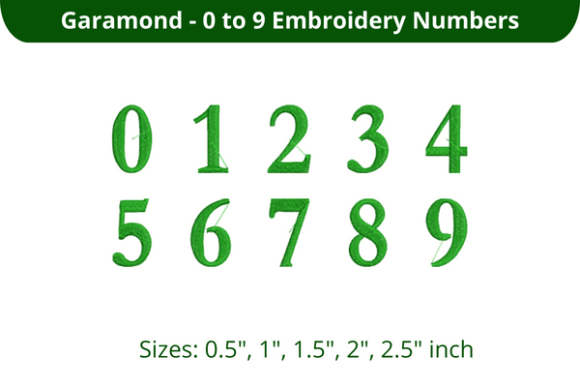
Garamond Font 0-9: Elegant Digits for Brand-Forward Merch
First Impression: Timeless Clarity Meets Small Business Practicality
As an embroidery designer who’s digitized over 2,000 commercial projects for cafés, boutiques, florists, and handmade studios, my first thought on seeing Garamond Font 0-9 wasn’t “pretty font”—it was “this could anchor a brand.” Garamond carries quiet authority: classic serif structure, balanced proportions, and subtle contrast between thick and thin strokes. Unlike script fonts that risk illegibility or blocky sans-serifs that feel generic, Garamond Font 0-9 delivers elegance without pretension—ideal for businesses that want to signal care, craftsmanship, and consistency. It reads as premium but approachable—perfect for a local bakery stamping “Est. 2021” on aprons, a florist numbering seasonal bouquets on tote bags, or a pet brand labeling custom collars with serial digits.
Where It Shines in Real Small Business Use
Garamond Font 0-9 isn’t just decorative—it’s functional branding infrastructure. In embroidered patches, its clean letterforms hold up beautifully at 1.5–2 inches tall, making it ideal for chest logos on staff uniforms or sleeve accents on boutique work shirts. On caps, it works best on structured front panels (not curved bill edges), where its vertical rhythm reinforces professionalism—think “Lot #47” stitched subtly above a café logo on barista caps. For tote bag design, it excels as a minimalist footer: “Batch • 2024 • Hand-Poured” adds narrative weight without clutter. As apron embroidery on linen or cotton canvas, the font’s open counters and generous x-height prevent fill-in during washing—critical for food-service or studio environments.
It also supports scalability across product tiers: use smaller sizes (8–10 pt equivalent) for product packaging accents (e.g., batch codes on soap labels or ceramic tags), and larger iterations (14–16 pt) for event merch like limited-edition festival totes or Back To School spirit bags for indie bookshops or art supply studios. Because it’s a machine embroidery design built for names, dates, and quotes, it integrates seamlessly into custom apparel workflows—no need to re-digitize numerals separately when adding client names to graduation caps or workshop participant totes.
Where to Apply Thoughtful Embroidery Judgment
Even elegant fonts demand context-aware execution. Garamond Font 0-9 should be used carefully on highly textured fabric (like burlap or heavy twill), where fine serifs may blur or snag. On dark uniforms, confirm thread color contrast early—light ecru or charcoal grey often reads cleaner than stark white for subtle branding. Avoid pushing it below 3/8 inch height in finished embroidery; at tiny patch sizes (<1 inch), the delicate crossbars and foot serifs can collapse under stitch density, especially on low-stabilizer applications. Curved surfaces—like cap crowns or rounded ceramic tags—require manual digitizing adjustments; this embroidery file is optimized for flat or gently contoured substrates.
Also note: while its classic tone builds trust, it may feel too formal for hyper-playful brands (e.g., children’s toy shops or neon-lit skate brands). Pair it intentionally—not as a standalone quirk, but as part of a cohesive system. If your design assets include hand-drawn icons or watercolor logos, Garamond Font 0-9 provides intelligent contrast, not contradiction.
How It Strengthens Brand Identity & Customer Trust
In small business merch, consistency isn’t just visual—it’s psychological. When customers see the same refined numeral set across aprons, tote bags, and product labels, they register reliability. Garamond Font 0-9 elevates perceived value: a handmade candle brand using it for batch numbers signals attention to detail; a florist applying it to gift tags implies care in curation. That quiet confidence translates directly to customer engagement—shoppers linger longer on items that feel intentional, not templated. And because it avoids trend-driven gimmicks, it future-proofs your brand identity. A 2024 tote bag with Garamond Font 0-9 won’t look dated by 2026. That longevity matters for Etsy sellers building repeat buyers and craft businesses investing in reusable design assets.
Practical Designer Notes Before You Stitch
- Always test in black and white first—verify legibility before committing to thread colors.
- Check performance at your smallest intended patch size; run a 1-inch sample before bulk production.
- Review spacing: kerning between numerals (e.g., “19” or “68”) must remain open—tight pairs risk stitching overlap.
- Confirm hoop size compatibility with your embroidery machine; some Garamond-based files require mid-size hoops (5x7") for optimal tension.
- Test on real fabric, not just stabilizer—especially for high-wash items like aprons or staff shirts.
- Use cutaway or tear-away stabilizer appropriate for fabric texture; lightweight stabilizer may cause shifting on knits.
- Create a printable mockup for client approval—show how Garamond Font 0-9 integrates with existing logos or layout elements.
- Compare it beside your other design assets: does it harmonize with your logotype, icon set, and typography hierarchy?
- Verify commercial licensing before use in paid merchandise—this is essential for Etsy sellers, wholesale partners, and retail pop-ups.
Final Thought: More Than Digits—A Design Decision With Momentum
Garamond Font 0-9 isn’t just another embroidery file. It’s a tool for signaling intentionality in every stitch. Whether you’re embroidering a single-digit logo for a new pet brand or numbering 200 tote bags for a Back To School artisan fair, this machine embroidery design supports clarity, cohesion, and quiet distinction. For small business owners and embroidery shops alike, choosing Garamond Font 0-9 says you value both beauty and function—and that’s exactly what turns custom apparel into trusted brand touchpoints.